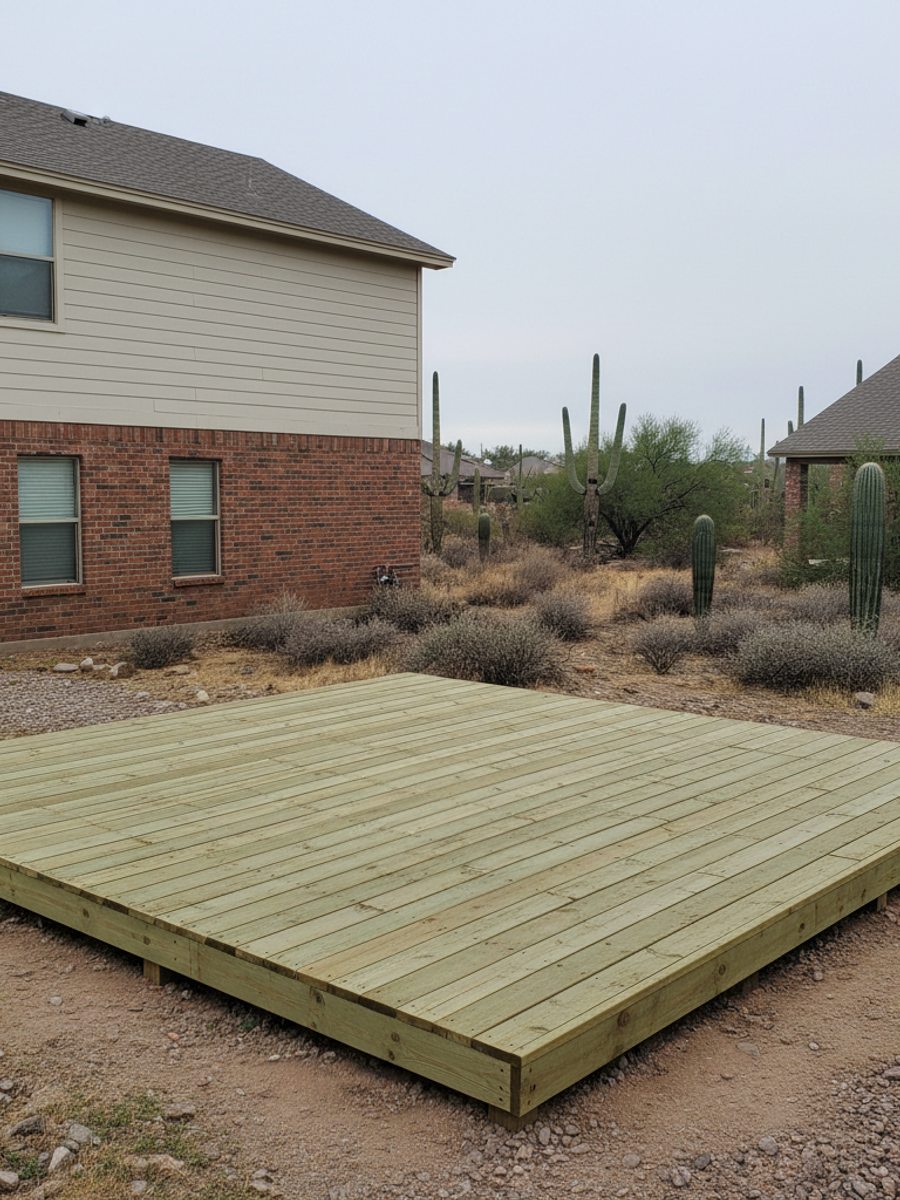
Anyone with a truck and a nail gun can call themselves a deck builder in the Valley. There's no state license requirement for handyman-level work under $1,000, and a lot of decks around Phoenix get built by guys who never cross that line on paper even though the job is worth ten times that. Knowing what to ask separates the ones who understand this ground and this climate from the ones who learned decking in a place with real winters and different soil.
Start with the license, then check what it actually covers
Arizona contractors doing structural work like decks should hold a Residential Contractor's license through the Arizona Registrar of Contractors, and it's a two-minute lookup on the ROC website to see if it's current and what complaints, if any, are on file. Ask for the license number before you ask for a bid. A builder who hesitates on that question is telling you something.
Bonding and insurance matter separately from the license. If a worker gets hurt on your property and the company has no workers' comp, that liability can land on you. Ask for a certificate of insurance, not just a verbal yes.
Know what's underneath your yard
Most of the Phoenix basin sits on caliche, a hardpan layer of calcium carbonate that can start anywhere from a few inches to a couple feet down and runs harder than concrete once you hit it. Post footings for a deck typically need to go 18 to 24 inches deep depending on the span and load, and if a crew hits caliche at 10 inches they either need to break through it with an auger bit or a jackhammer, or they need to redesign the footing. A builder who quotes a flat footing price without ever mentioning caliche either hasn't dug in your neighborhood before or is planning to shortcut it. That shortcut shows up years later as a post that's shifted or a deck that's started to rock at the rail.
Older neighborhoods like Arcadia, Encanto-Palmcroft, and parts of central Phoenix often have decks going onto homes built in the 1940s through 60s, where the original slab, plumbing stub-outs, and even old irrigation lines aren't always where the plans say they are. Newer subdivisions out in Queen Creek, Buckeye, or Verrado are usually digging into cleaner, more predictable fill, but caliche still shows up plenty.
Ask how they're building for the heat and the monsoon, not just for looks
Composite decking is popular here because it doesn't need refinishing, but dark-colored composite can hit surface temperatures well over 150°F on a July afternoon, hot enough to burn bare feet. A builder who's worked in Phoenix long enough will steer you toward lighter colors or capped composite with better heat reflectance, especially on a west-facing deck with no shade structure planned.
Wood decking moves differently here than it does in humid climates. Redwood and cedar can shrink and check as they dry out fast in single-digit humidity, so fastener spacing and gapping between boards has to account for that, not just for wet-climate expansion. A crew that gaps boards the same way they would in Seattle is going to give you cupped, split decking within a couple summers.
Monsoon season runs roughly mid-June through the end of September, and wind gusts during a monsoon storm can hit 50 to 60 mph. That matters for how a deck attaches to the house. The ledger board connection, the one thing holding the whole structure to your wall, needs proper flashing and lag bolts or structural screws rated for the load, not just deck screws driven in fast. Ask specifically how the ledger will be flashed and fastened. If the answer is vague, that's a problem, because a ledger failure is how decks actually collapse.
Permits aren't optional, and skipping them costs you later
In the City of Phoenix and most surrounding jurisdictions like Mesa, Chandler, and Scottsdale, a deck attached to the house or built more than 30 inches above grade needs a building permit, and that permit triggers inspections, typically one for the footings before they're covered and one final inspection when the structure and railing are done. Guardrails are required once you're 30 inches up, and the code generally wants a 36-inch minimum rail height with balusters spaced so a 4-inch sphere can't pass through.
A contractor who tells you permits aren't necessary, or offers to skip it to save time, is putting the risk on you. Unpermitted decks show up during a home sale inspection and can force a buyer to walk or force you to tear out and redo the work. If your property is in an HOA, and a lot of newer Phoenix-area communities like Anthem, Verrado, and parts of Ahwatukee are, you'll likely need HOA design approval on top of the city permit, sometimes with restrictions on height, color, or how close the structure can sit to a property line.
What to walk away from
- A bid that's dramatically lower than every other quote with no explanation. Someone's cutting corners on footing depth, lumber grade, or fasteners.
- Full payment demanded upfront. A deposit is normal. The whole job, before a single post hole is dug, is not.
- No written contract, or one that doesn't spell out footing depth, board spacing, fastener type, and who's pulling the permit.
- Vague answers about the ledger attachment. This is the single point of failure on an attached deck and it should not be a mystery.
- A builder who's never mentioned caliche, monsoon wind loads, or heat expansion unprompted. If they've worked here a while, this stuff comes up on its own.
A deck here has to survive 110-degree summers, a monsoon season with real wind, and soil that fights back when you try to dig into it. That's a different job than building one in Denver or Atlanta, and it's worth finding someone who treats it that way. If you want to talk through what a specific yard and layout would actually take, Western Deck Solutions handles the design, the permit, and the digging in this ground every week.